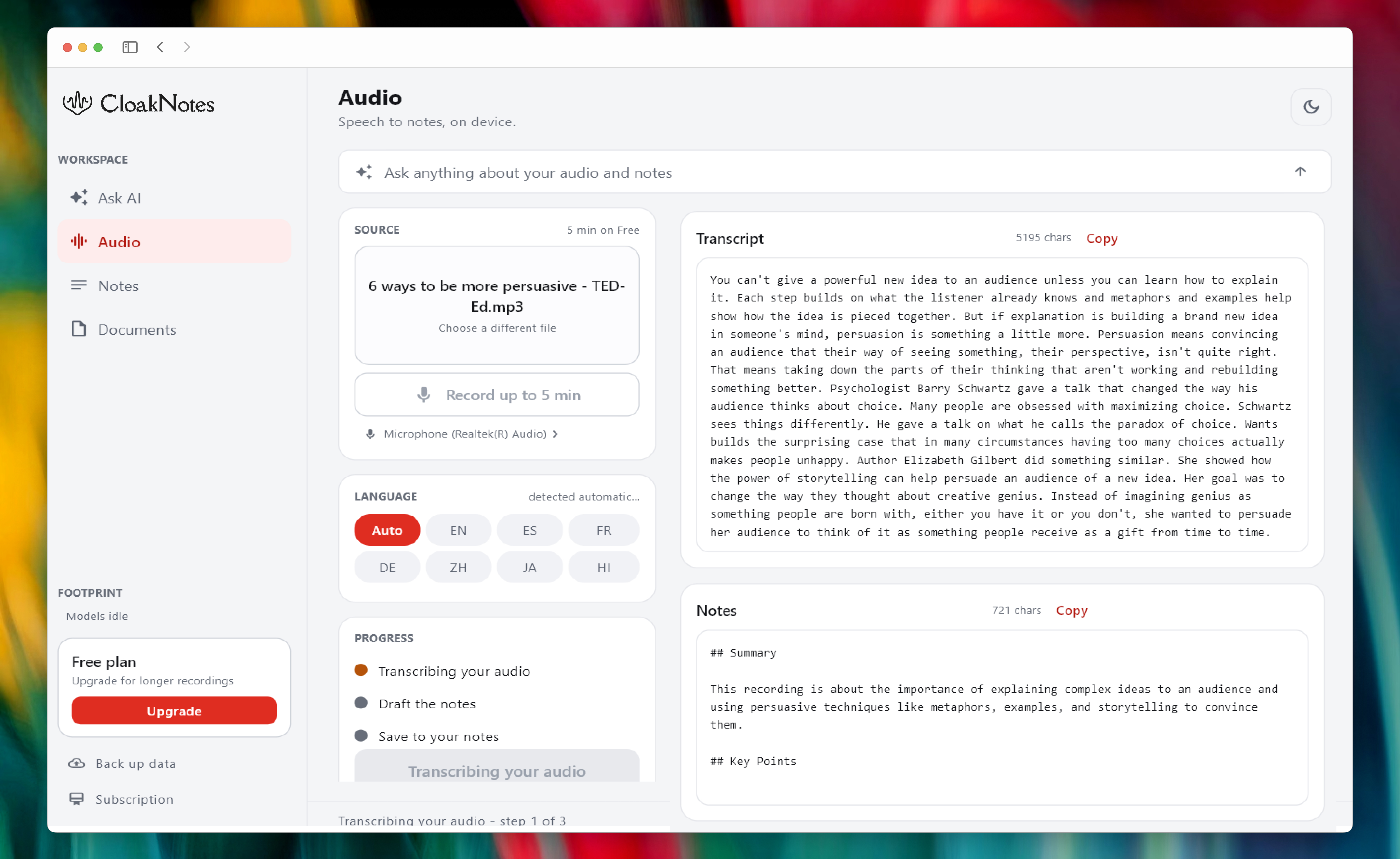
CloakNotes — Private AI Workspace
On-device audio workspace running quantized INT4 LLMs with <1.1GB RAM active footprint and zero cloud latency.
Per-Frame Processing Latency
3.4 ms
Locked 60 FPS
Active Memory Footprint
32 MB
Thermal Throttling Onset
> 45 minutes
Works on
Built with
01 / The Problem & Hard Constraints
Translating physical environments into tactile feedback requires processing high-resolution camera streams and 3D depth maps (LiDAR/Time-of-Flight) in real-time.
02 / Architecture & Core Design Decisions
03 / Deep Technical Challenges & Solutions
The Challenge: Jitter and False Positives in Depth Translation. Translating raw LiDAR depth values directly to haptic intensity meant that walking past a window (which absorbs/scatters infrared light) caused sudden, violent vibration spikes, disorienting the user.
The Solution: Temporal Smoothing & Kalman Filtering. I implemented a lightweight 1D Kalman filter and a sliding-window temporal average over the depth matrix. Before a haptic signal is fired, the engine evaluates the current frame against the previous 4 frames. This mathematical smoothing eliminated infrared scattering artifacts, resulting in a smooth, radar-like tactile pulse that accurately reflects solid geometry.
Benchmarks
| Metric | Standard Camera API Pipeline | HapticAR Native FFI Pipeline |
|---|---|---|
| Per-Frame Processing Latency | 22 ms (Dropped Frames) | 3.4 ms (Locked 60 FPS) |
| Active Memory Footprint | 240 MB (Buffer Bloat) | 32 MB |
| Thermal Throttling Onset | ~4 minutes of continuous use | > 45 minutes |
| False-Positive Collision Rate | High (Raw Sensor Noise) | < 1% (Temporal Filtering) |
On-device audio workspace running quantized INT4 LLMs with <1.1GB RAM active footprint and zero cloud latency.
120 FPS sim-racing telemetry HUD with zero-allocation binary parsing and direct GPU canvas repainting.
Offline-first field operations client with vector clock conflict resolution and viewport-based CAD tile rendering.