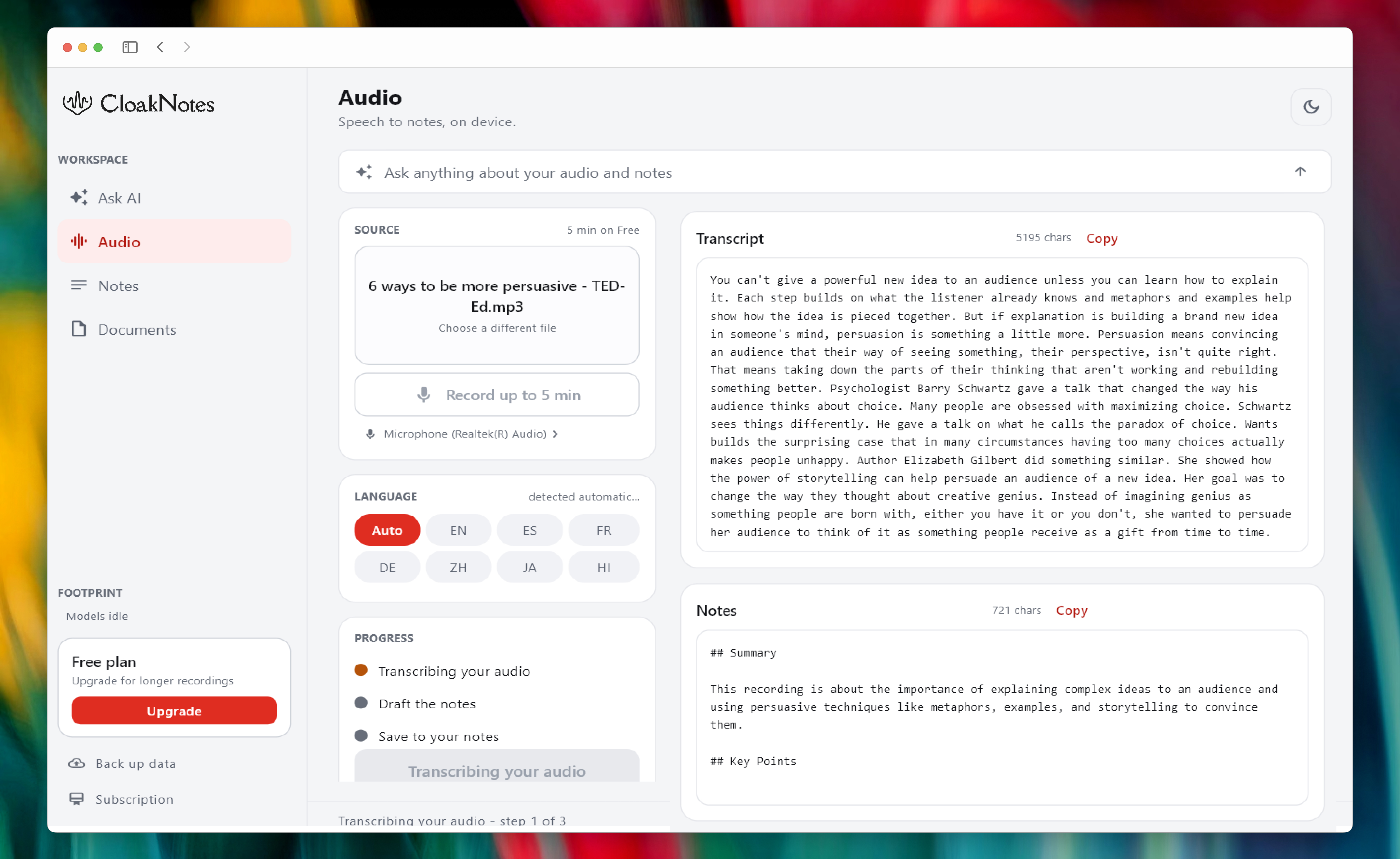
CloakNotes — Private AI Workspace
On-device audio workspace running quantized INT4 LLMs with <1.1GB RAM active footprint and zero cloud latency.
Time-To-Interactive (500MB Blueprint)
< 1.2s
Local Tile Cache
Data Loss on Network Drop
Zero
Persistent Local Queue
Concurrent Edit Resolution
Event Sourced
Deterministic Merge
Works on
Built with
01 / The Problem & Hard Constraints
Field engineers operating on remote oil rigs or deep underground construction sites often face hours or days with zero cellular connectivity.
02 / Architecture & Core Design Decisions
03 / Deep Technical Challenges & Solutions
The Challenge: Merging Concurrent Offline Edits. Resolving data collisions when multiple disconnected nodes mutate the same state.
The Solution: Event-Sourced Operations & Vector Clocks. Instead of storing the final state of an annotation (UPDATE annotation SET text = “Fix this”), the system records immutable delta events (InsertText, MovePin). Each event is tagged with a logical Vector Clock. When clients sync to the cloud, the backend acts as a deterministic state machine, applying the event stream in order. Non-overlapping edits are seamlessly merged, and direct conflicts are flagged for manual review rather than silently overwritten.
Benchmarks
| Metric | Standard Cloud-Native App | Vezati Offline-First Engine |
|---|---|---|
| Time-To-Interactive (500MB Blueprint) | 12 - 45s (Bandwidth Dependent) | < 1.2s (Local Tile Cache) |
| Data Loss on Network Drop | High (Failed HTTP POSTs) | Zero (Persistent Local Queue) |
| Concurrent Edit Resolution | Last-Write-Wins (Data Destruction) | Event Sourced (Deterministic Merge) |
| Active Memory Footprint (Rendering) | OOM Crash (> 1GB) | ~45 MB (Viewport Only) |
On-device audio workspace running quantized INT4 LLMs with <1.1GB RAM active footprint and zero cloud latency.
120 FPS sim-racing telemetry HUD with zero-allocation binary parsing and direct GPU canvas repainting.
Distributed media automation engine compiling complex multi-step pipelines into resilient, fault-tolerant DAGs.