
Vezati — Field Operations Platform
Offline-first field operations client with vector clock conflict resolution and viewport-based CAD tile rendering.
Max Task Duration
Unbounded
Hours/Days
Failure Blast Radius
Isolated to Single Node
Broker Memory / 1k Jobs
12 MB
Claim-Check Pattern
Works on
01 / The Problem & Hard Constraints
Automating heavy media processing (e.g., 4K video transcoding, multi-gigabyte audio transcription via Whisper) fundamentally breaks standard synchronous web architectures.
02 / Architecture & Core Design Decisions
03 / Deep Technical Challenges & Solutions
The Challenge: Handling GPU Worker Crashes & Pipeline Resumption. AI inference nodes frequently crash due to hardware faults or VRAM exhaustion. Standard systems fail the entire pipeline, wasting compute resources and time.
The Solution: Checkpointing & Idempotent Executions. Every node execution was made strictly idempotent. Before executing a node, the worker queries the database to check if a valid output artifact already exists for that specific node’s hash. If a worker dies mid-execution, the orchestrator detects the missed heartbeat and requeues the task. The new worker resumes the DAG exactly at the failed node, utilizing the intermediate S3 artifacts generated by previous steps.
Benchmarks
| Metric | Synchronous API Architecture | Stralis Distributed DAG Engine |
|---|---|---|
| Max Task Duration | < 60 seconds (Gateway Timeout) | Unbounded (Hours/Days) |
| Failure Blast Radius | Entire Pipeline Fails | Isolated to Single Node |
| Broker Memory / 1k Jobs | ~2.5 TB (Payload in Queue) | 12 MB (Claim-Check Pattern) |
| Pipeline Resumption Time | 100% Restart Penalty | 0% (Resumes at Failure Point) |
Offline-first field operations client with vector clock conflict resolution and viewport-based CAD tile rendering.
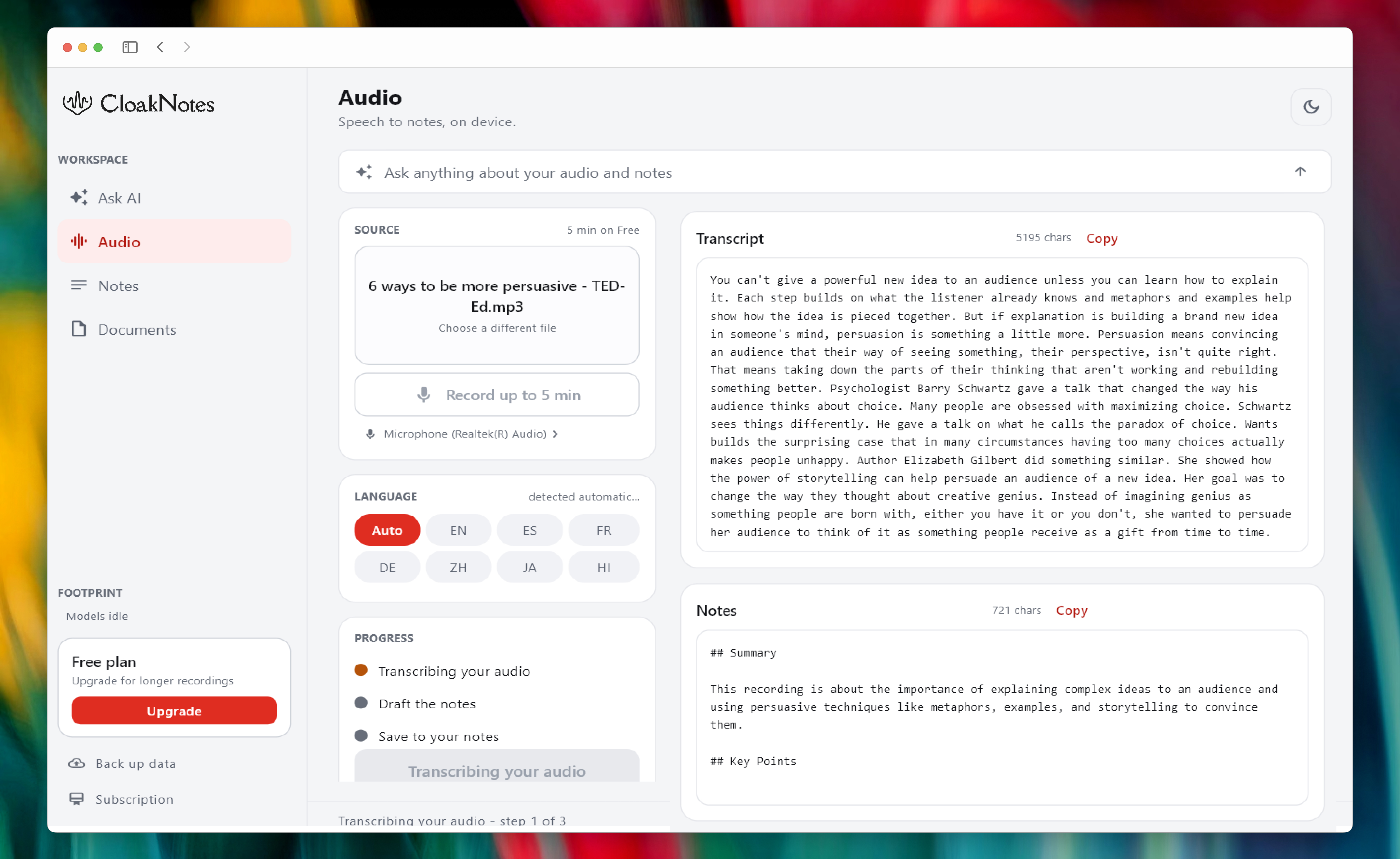
On-device audio workspace running quantized INT4 LLMs with <1.1GB RAM active footprint and zero cloud latency.

120 FPS sim-racing telemetry HUD with zero-allocation binary parsing and direct GPU canvas repainting.